How Revolut, Ecosia and Uber cut LLM costs by up to 90% with open source models
Some Revolut engineers were spending up to $10,000 a month each on an AI coding tool. Then Revolut moved coding to open-weight models and its AI coding bill fell by about 90%. Ecosia, BNP Paribas, Airbnb, Uber, Pinterest and AT&T made the same move.
Published
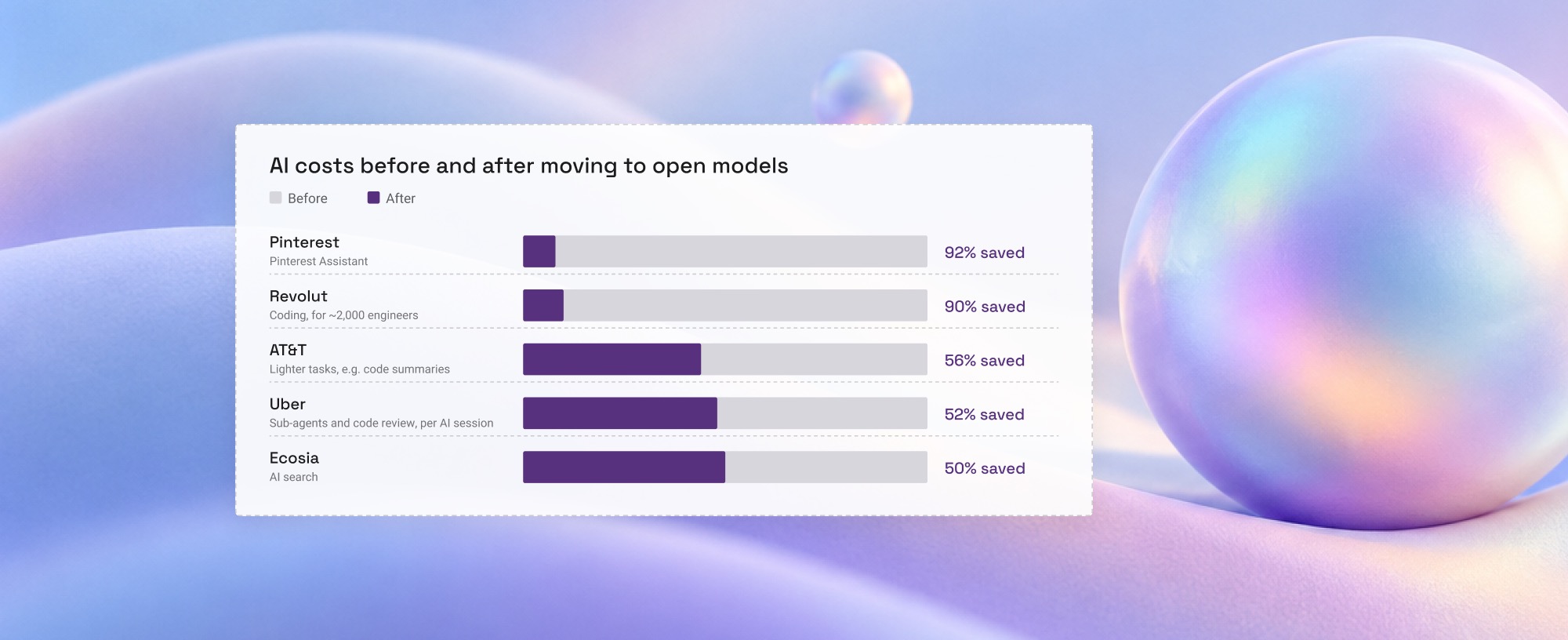
None of these companies dropped closed models. They moved the high-volume, lower-risk work to open models and kept the hardest tasks on a frontier model. That is where the savings came from.
This post covers what each company moved, what it saved and what it kept. Then it shows what the same move costs a small team, which open model to try for which task, what the switch looks like in code, and a checklist you can run this week. It is written for product and engineering leads at European companies that handle sensitive data.
Key takeaways
- Seven companies moved real AI workloads to open-weight models and reported savings from about 50% to over 90%.
- None went all-or-nothing. The hardest tasks, and tasks with images, stayed on closed models.
- They started with the lighter, high-volume work: summaries, ticket handling, sub-tasks and support answers.
- Revolut and BNP Paribas run the models where they control the data. For a European team, that means inference inside the EU.
- You don't need your own inference stack to do the same. An OpenAI-compatible API changes a URL, a key and a model name.
Europe: 3 companies that cut AI costs under strict data rules
Revolut: AI coding bill down about 90%
Revolut handles financial data and a large codebase, two of the most sensitive things a company owns. In early 2026 its engineers used Claude Code, and some spent $1,000 to $10,000 a month each with little return.
The team then made open-weight GLM models its default for coding, running on its own infrastructure, for about 2,000 engineers. The biggest gains came from debugging and handling tickets, not from writing new code.
- Result: AI coding costs fell by about 90%, coding time improved by 60%, lead time by 70% (The Register, November 2026).
- What they kept: closed models still handle tasks with images, through a router. Revolut did not drop closed models completely.
- On privacy: Revolut's infrastructure lead said the concern with these models is sending data to an API abroad. Running them in your own region removes it.
Ecosia: costs roughly halved, quality up
Ecosia, the Berlin search engine, moved its AI search from OpenAI to Mistral in May 2026. Five months later it moved again, to open-weight models, through a German platform.
- Why: CEO Christian Kroll said Ecosia was "too large a customer for Mistral", with overloaded servers, and was disappointed with the quality.
- Result: Kroll said the switch "roughly cut our costs in half while improving quality and performance" (PPC Land, October 2026). No baseline figures were published.
- The lesson: the choice is not only closed vs open. Being able to change models without a rebuild is what let Ecosia move twice in one year.
BNP Paribas: open models inside its own data centers
BNP Paribas, with nearly 178,000 employees, built an internal "LLM as a Service" platform in its own data centers. It runs open-source models alongside Mistral models (BNP Paribas, June 2025).
- Why: secure deployment inside the group's infrastructure, data privacy requirements, and shared costs across business lines.
- What it shows: a bank under EU banking and data rules decided open models were good enough for production.
Beyond Europe: Airbnb, Uber, Pinterest and AT&T
| Company | What moved to open models | Result |
|---|---|---|
| Airbnb | Its customer service agent runs on 13 models and relies heavily on Qwen | CEO Brian Chesky: Qwen is "fast and cheap"; OpenAI models are rarely used in production (Fortune) |
| Uber | Sub-agents for smaller tasks and code review | Cost per AI request down 34%, per AI session down 52% (The Pragmatic Engineer) |
| Pinterest Assistant, on open models post-trained in-house | Cost per transaction under 8% of comparable closed models (The Pragmatic Engineer) | |
| AT&T | Lighter tasks such as summarising code; code generation stays on frontier models | Costs down by up to 56%, with quality down only 2% (The Pragmatic Engineer) |
How much companies saved with open models
Moving to open models cut AI costs by 50% to over 90%
Each company measured it differently: the small line under each bar says what was measured
- Pinterest, Outside Europeover 92%cost per transaction vs comparable closed models
- Revolut, European companiesabout 90%AI coding costs
- AT&T, Outside Europeup to 56%costs on the tasks moved
- Uber, Outside Europe52%cost per AI session
- Ecosia, European companiesabout 50%total AI costs, per the CEO
Sources: The Register (Revolut), PPC Land (Ecosia), The Pragmatic Engineer (Uber, Pinterest, AT&T). BNP Paribas published no figures.
The range is wide because the companies moved different shares of their traffic. The more volume moved, the bigger the cut.
What the 7 cases have in common
- They started with the lighter work. Summaries, ticket handling, sub-tasks, support answers. Uber and AT&T kept the hardest tasks on frontier models and moved everything else.
- None of them went all-or-nothing. Revolut, Uber and AT&T route between open and closed models. The savings come from moving the bulk of the volume, not every call.
- Savings ran from about 50% to over 90%. The spread depends on how much of the traffic moved and what it ran on before.
- Quality held. Ecosia reported better quality after the switch. AT&T measured a 2% drop on the tasks it moved.
- Data location mattered as much as price. Revolut and BNP Paribas both run the models where they control the data. For a European company, that means inference inside the EU.
What these numbers don't show
Each company measured something different: total cost, cost per session, cost per transaction or cost on the tasks it moved. The figures are self-reported, and most come from teams far larger than yours.
Treat them as direction, not a forecast. Your own savings depend on how much of your traffic you move and what it runs on today. The only number that counts is the one from your own test, which the checklist below walks you through.
What open models cost a 10 to 50 person team
Revolut and BNP Paribas built their own inference stacks, with their own teams to run them. Most product companies cannot justify that for one AI feature.
You can get the same economics without the stack. An OpenAI-compatible inference API, hosted in the EU, lets you point existing code at a new endpoint and pick an open model. The integration work is closer to a URL change than a rebuild.
Example: a support assistant answering 50,000 tickets a month
Each request sends 6,000 input tokens: 5,000 tokens of instructions and help-center context that are the same every time, so they are served from the prompt cache, and 1,000 tokens of the ticket itself. Each answer is 400 tokens. That adds up to 250M cached input tokens, 50M uncached input tokens and 20M output tokens a month.
| Model | Price per 1M tokens (input / cached input / output) | Monthly cost |
|---|---|---|
| Claude Sonnet 5.5 (closed) | $2.00 / $0.10 / $10.00 | $325 |
| GLM 5.3 on Entrim | $0.50 / $0.15 / $2.00 | $102.50 |
| DeepSeek V4.1 Flash on Entrim | $0.20 / $0.005 / $0.60 | $23.25 |
| Qwen 3.8 27B on Entrim | $0.10 / $0.04 / $0.40 | $23 |
On this workload, Qwen 3.8 27B costs about 93% less than Claude Sonnet 5.5. The Claude figure leaves out Anthropic's fee for writing to the cache, so the real gap is a little wider. Prices are list prices on 12 November 2026. Quality is not compared here: that is what your own test set is for.
Two things decide most of the bill. Output tokens cost the most per token, so short answers matter. And repeated context is billed at the cached rate: on Entrim, coding-agent workloads average a 97% cache hit rate (see the Qwen 3.8 27B page).
Same model, different provider
The provider matters too, not only the model.
Same model, same tokens: Entrim costs about 82% less a month
Qwen 3.8 27B, 10B tokens a month: 8.7B cached, 364M input, 909M output
Up to 82% lower than the most expensive provider
- CoreWeave, Other providers$4,178
- NovitaAI, Other providers$3,619
- AkashML, Other providers$3,508
- Entrim, Entrim$748
Monthly cost computed from each provider's price per 1M tokens for input, output and cached tokens
Prices per 1M tokens from the cost comparison on entrim.ai on 11 November 2026. Prices change; see the live comparison.
The model is the same in every row. The difference is only what each provider charges to run it.
Which open model to try first, by task
Start with one model per task, test it on your own examples, and only then compare a second one.
| Your task | Start with | Why | Price per 1M tokens (input / output) |
|---|---|---|---|
| Summaries, extraction, classification, ticket triage | Qwen 3.8 27B | Low price, and thinking can be switched off per request to keep answers short | $0.10 / $0.40 |
| Agent loops that read screenshots, on a tight budget | GLM 5.3 Flash | Built for long, cheap agent runs that mix code, screenshots and recordings | $0.10 / $0.35 |
| Long context, image input, fast agentic work | DeepSeek V4.1 Flash | Long context, image input and a reasoning dial, with short outputs | $0.20 / $0.60 |
| Coding agents, long refactors, deep debugging | GLM 5.3 | The model family Revolut runs; built for engineering runs that last hours | $0.50 / $2.00 |
Keep complex reasoning and image-heavy work on your current model until your test says otherwise.
What switching looks like in code
If your code already uses the OpenAI SDK, three things change: the base URL, the API key and the model name.
from openai import OpenAIimport os client = OpenAI( base_url="https://api.entrim.ai/v1", api_key=os.environ["ENTRIM_API_KEY"],) response = client.chat.completions.create( model="Qwen/Qwen3.8-27B", messages=[{"role": "user", "content": "Summarise this support ticket: ..."}],)print(response.choices[0].message.content)The rest of the work is testing. Prompts tuned for one model often need small changes for another, so run your test set before you move live traffic.
Why it matters where inference runs
Many open-model APIs run in the US. For a European company, any personal data in a prompt sent there leaves the EU, with the paperwork and risk that come with it. Revolut and BNP Paribas avoided this by running the models themselves.
The part that needs the most care is the data agreement. If your product touches candidate profiles, patient notes, contracts or financial records, ask for the guarantees in writing before you send a single real record.
Checklist: your first move
Pick the first workload
- List your AI calls by volume. The top 2 or 3 usually carry most of the bill.
- Pick one high-volume, lower-risk task: summaries, classification, extraction, internal Q&A, ticket triage.
- Keep the hardest task (complex reasoning, images) on your current model for now.
- Save 50 to 100 real examples with the answers you consider good. This is your test set.
- Run the same set through 2 open models and compare quality, speed and cost per 1,000 calls.
- Move 10% of live traffic first, watch for a week, then move the rest.
5 questions to ask an inference provider
- Data retention: is zero data retention guaranteed, and is it written into the DPA?
- Logging: are prompts or outputs logged, and for how long?
- Training: is my data ever used to train or improve models?
- Location: where exactly does inference run, and does any data leave the EU?
- Model versions: which exact model versions are served, are they quantized, and how will I know before a version changes?
How Entrim answers the first 4 is in our privacy policy. You can request a DPA and Zero Data Retention by talking to sales. For model versions, ask the team directly.
Run the test on your own data
Entrim is a European inference API for open models, behind one OpenAI-compatible endpoint. The lineup includes GLM 5.3, the same model family Revolut runs, plus DeepSeek V4.1 Flash and Qwen 3.8 27B (models and prices).
Inference runs in Entrim's own data center in Slovenia. Prompts and outputs are not logged and never used for training. A DPA and Zero Data Retention are available for stricter requirements (data privacy).
| Get started free → | Check our models → | Data privacy → |
|---|---|---|
| Run the checklist on your own data with free credit | GLM 5.3, DeepSeek, Qwen and more, with prices per 1M tokens | Where inference runs, what is never logged, how to get a DPA and Zero Data Retention |
Need a DPA before you test? Talk to sales.

Get new posts by email
New articles from the Entrim blog, sent to your inbox when they're published.
Unsubscribe anytime.
Published